


Casement and awning windows are hinged windows that swing outward, usually with a crank. A casement is hinged on the side and opens like a door; an awning is hinged at the top and opens from the bottom. Both have a single sash, which helps them seal tightly when closed. This guide explains how each one works, how they compare with double-hung windows, where they fit best, and what to know about egress, screens and energy.
How Casement Windows Work
A casement window is hinged on the left or right side and swings outward when you turn the crank. Open fully, it lets air in from the top of the opening to the bottom, and Andersen notes the open sash leaves room to clean both sides of the glass from inside. When closed, the locking hardware pulls the sash tight into the frame. Casements are typically taller than they are wide, and some lines offer very large sizes.
How Awning Windows Work
An awning window has a single sash hinged at the top that swings outward from the bottom, opened with a crank or a handle. The open sash forms a canopy over the opening, which is why Pella, Marvin and Andersen all note that it can stay open in light rain. Awning windows are usually wider than they are tall and are often placed high on a wall for privacy, above another window, or in a basement where wall space above ground is limited.
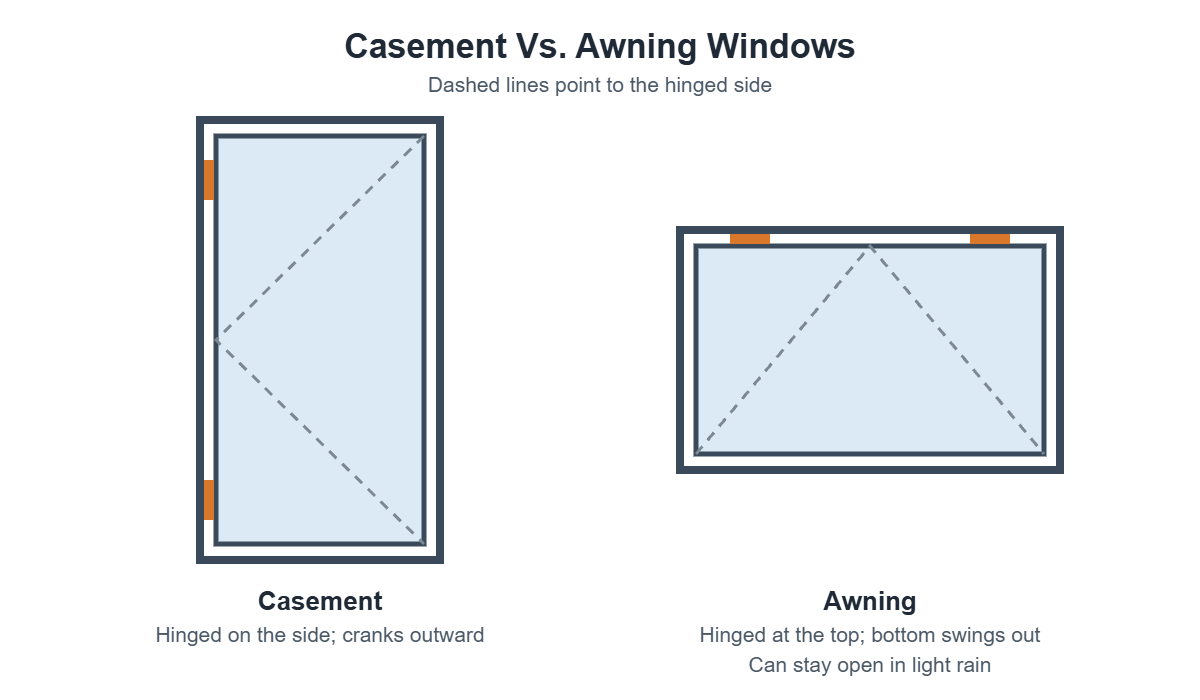
Casement Vs. Awning Vs. Double-Hung
| Feature | Casement | Awning | Double-Hung |
|---|---|---|---|
| Hinge | Side | Top | None (sashes slide) |
| Opens | Outward, like a door | Outward from the bottom | Up and down |
| Ventilation | Whole sash opens | Whole sash opens; can stay open in light rain | Half the window at most |
| Air sealing | Lock pulls sash against the frame | Lock pulls sash against the frame | Sliding seals |
| Typical shape | Taller than wide | Wider than tall | Taller than wide |
| Egress | Can be ordered to meet egress | Generally not | Possible in larger sizes |
| Screen location | Inside | Inside | Varies by model |
For the sliding alternative, see our double-hung window guide.
Air Sealing And Energy Efficiency
Andersen describes casement and awning windows as among the most energy-efficient window types, second only to fixed picture windows. It credits the single-sash design, which leaves fewer places for air to leak, and a seal that tightens when wind pushes against the window. Stanek Windows makes the same point: the lock pulls the sash against the frame and weatherstripping, which tends to seal tighter than a double-hung. As with any window, compare NFRC ratings and ENERGY STAR certification for your climate zone.
Egress
A casement opens almost its full width, so it can meet bedroom escape requirements at a smaller overall size than a double-hung window. Renewal by Andersen notes that casements can be ordered to meet egress requirements, while awning windows do not meet egress requirements and are not suitable where egress is needed, such as basement bedrooms. Check the maker’s net clear opening figures for the exact size. See our egress window guide for the code requirements and our basement window guide for below-grade options.
Screens
Because the sash swings outward, an outside screen would block it. Casement and awning screens mount on the inside of the frame. Simonton, for example, notes that its casement screens sit on the inside of the window.
Where Each Type Works Best
Casement Windows
- Over kitchen sinks and counters, where a crank is easier to reach than lifting a sash.
- Modern homes, where a single sash and slim frame suit the look.
- Beside fixed picture windows, and as the opening side units of a bay or bow window.
- Bedrooms that need an egress window in a smaller size.
Awning Windows
- High on a wall in bathrooms and bedrooms for privacy and ventilation.
- Above or below a fixed picture window.
- Basements, where wall space above ground is limited.
- Rooms where you want fresh air during light rain.
Things To Watch
- An outward-swinging sash can get in the way next to a walkway, deck or patio.
- Standard window air conditioners do not fit a casement or awning opening.
- Crank operators and hinges are moving parts that may need adjustment or replacement over time.
Pros And Cons
| Pros | Cons |
|---|---|
| Tight seal when locked | Sash swings into outdoor space |
| Full-sash ventilation | No standard window air conditioner |
| Easy to reach and crank over counters | Crank hardware can wear |
| Casements can meet egress in smaller sizes | Awnings do not meet egress |
| Awnings ventilate in light rain | More operating hardware than a fixed window |
Cost Factors
Price depends on the frame material, size, glass package, hardware finish, and whether the unit is a full-frame or insert replacement. Hinged windows have more operating hardware than a fixed window, and a casement replacing a double-hung may change the look of the opening. For installed cost ranges, see our window replacement cost guide, and for typical dimensions see our standard window sizes chart.
Who Makes Casement And Awning Windows
Nearly every window maker offers both. Our reviews cover Andersen, Marvin, Sierra Pacific, PGT and Ply Gem.
Frequently Asked Questions
What Is The Difference Between Casement And Awning Windows?
A casement is hinged on the side and opens like a door. An awning is hinged at the top and opens outward from the bottom.
Can Awning Windows Stay Open In The Rain?
In light rain, yes. The open sash forms a canopy that sheds water away from the opening.
Are Casement Windows Good For Egress?
They can be. Because the whole sash opens, a casement meets egress requirements at a smaller size than a double-hung. Awning windows generally do not qualify.
Are Casement Windows More Energy Efficient Than Double-Hung?
They usually seal tighter, because the lock pulls the sash against the frame. Compare NFRC ratings for the specific windows.
Sources
- Andersen, What Is A Casement Window
- Andersen, Awning Windows
- Renewal By Andersen, Awning Replacement Windows
- Pella, Awning Windows
- Marvin, Awning Windows
- Simonton, Casement Screen
- Stanek Windows, Double-Hung Vs. Casement Windows
- ENERGY STAR, Residential Windows, Doors And Skylights Key Product Criteria